The most comfortable Swiss journey isn’t always the one with a pass for every leg. To learn how to travel Switzerland in ultimate comfort while managing costs, match your ticket to your itinerary: the Swiss Travel Pass is available for 3, 4, 6, 8 or 15 consecutive days, while the Zürich Card covers local public transport for 24 or 72 hours. Choose around the places you plan to visit, not just the scenery you hope to see.
Switzerland’s trains, buses and mountain connections make it easy to travel between lakeside towns, alpine viewpoints and historic cities without driving. The key is matching your transport to your itinerary: a pass may simplify a multi-stop trip, while a local travel card or individual ticket may suit a shorter stay or a focused route.
This guide explains how passes, local travel cards and individual fares fit together, with practical tips for smoother journeys. You’ll learn how to plan comfortable connections through Switzerland and choose transport that works for your itinerary.
Key Takeaways
- Choose rail routes that make the journey part of the experience, then connect mountain destinations with the transport that best fits your plans.
- Compare trains, buses, cable cars and gondolas as one itinerary so each connection feels smooth rather than improvised.
- Look at Supersaver tickets and Half-Fare options alongside your travel pattern to find potential savings without sacrificing comfort.
- Use local travel cards for focused city stays, and consider a tailor-made tour when you’d rather leave route coordination to a guide.
1. Swiss rail travel and mountain connections
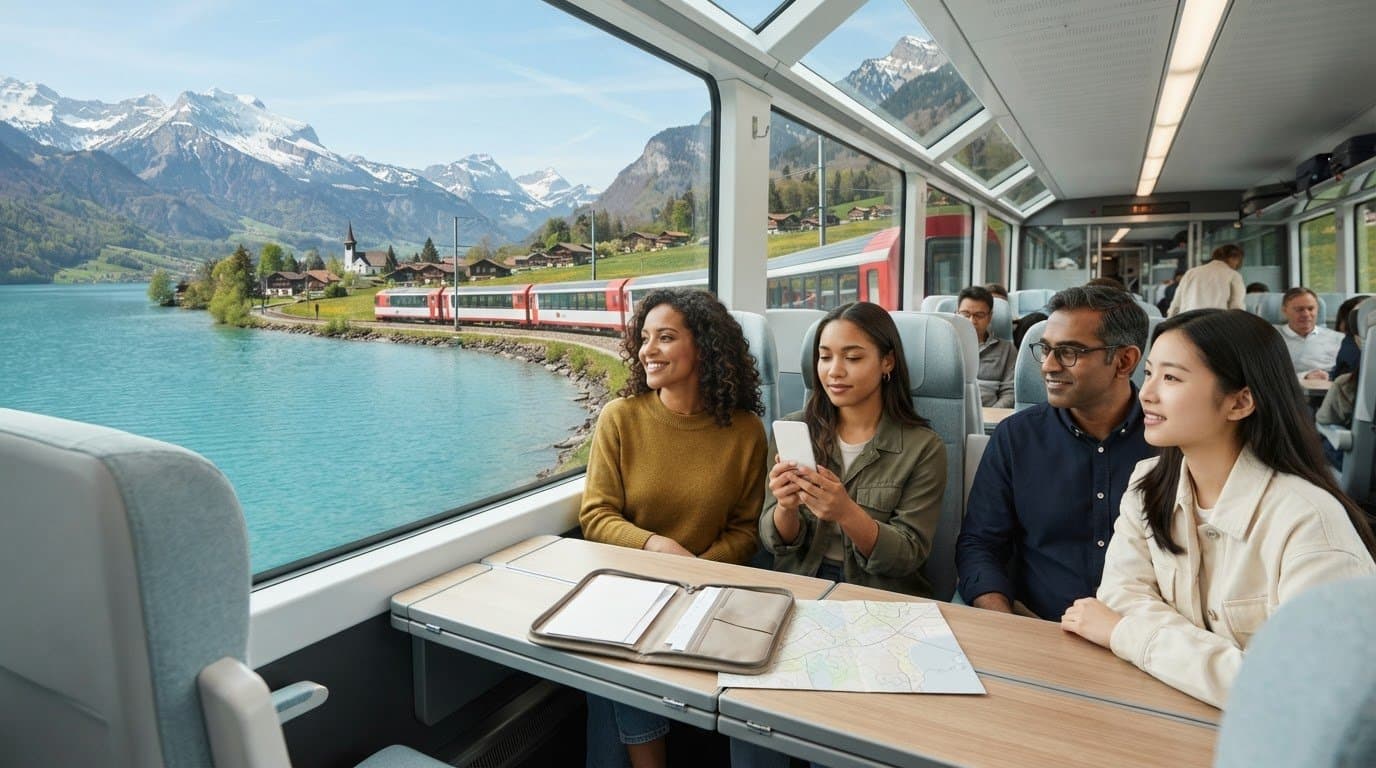
Swiss rail journeys link cities with alpine destinations while keeping the scenery in view. The Glacier Express takes eight hours between Zermatt and St. Moritz, crossing 291 bridges and passing through 91 tunnels. The Bernina Express route adds another dramatic connection, passing over 196 bridges and through 55 tunnels. Build these panoramic journeys into your route, then connect to local trains, buses, or mountain railways for the final ascent.
For a summit without a complicated transfer, compare viewpoints near your overnight base. From Zermatt, the Gornergrat railway reaches about 10,272 feet above sea level; from Lucerne, Mount Pilatus rises 7,000 feet above the city. Jungfrau exceeds 11,000 feet. A nearby viewpoint can reduce backtracking and leave more time for lakeside walks or a boat excursion on Lake Lucerne. Switzerland has 13 UNESCO World Heritage Sites, according to UNESCO World Heritage Centre, so consider pairing a rail journey with a historic city or cultural landscape.
For a refined hotel stay, choose a base around the experience you value: Zurich for city connections, Lucerne for lake and mountain excursions, or Zermatt for Matterhorn views. The best hotel depends on whether you want urban access, a lakeside setting, or an alpine village atmosphere.
For milder weather and potentially fewer crowds, consider travelling between the busiest holiday periods. Conditions vary with altitude, so plan city visits and high-mountain outings separately, and leave room to adapt your schedule.
Before setting out, protect your trip with travel insurance suited to your activities, and review ticket conditions and connection details before booking. Mountain weather can affect exposed viewpoints, so keep a lower-altitude alternative, such as a lakeside visit, in your itinerary. In mountain huts, dinner is typically served between 6:00 pm and 7:00 pm, and quiet hours usually begin around 10:00 pm. Arrive in time for the meal and respect the evening quiet.
2. Swiss trains, buses, cable cars and gondolas
For comfortable travel between cities, take the train and connect with buses or mountain transport for the final stretch. Trains work well for longer journeys; buses reach places beyond the rail network, while cable cars and gondolas take you to elevated viewpoints. Allow time for transfers rather than planning every connection too tightly.
For renowned panoramic rail journeys, consider the Glacier Express or Bernina Express. First class offers a more spacious rail experience. Check the booking and seat-reservation conditions for your specific train: a reservation and a ticket are not necessarily the same thing, so read the options for your chosen departure carefully.
Swiss trains run to published schedules, so arrive at the platform before departure and check station displays for your platform and connection. Keep your ticket accessible during transfers and follow local signs. A greeting or thank-you in Swiss German, French or Italian can make everyday interactions warmer; use the language spoken in the region you’re visiting.
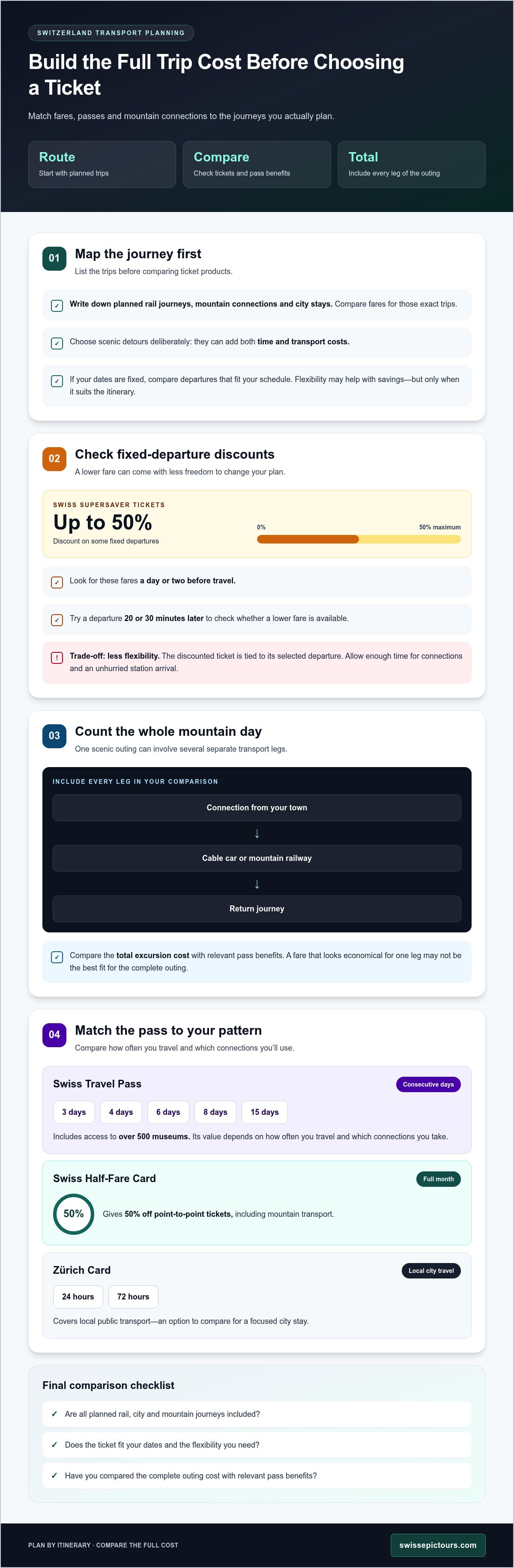
The Swiss Travel Pass covers consecutive periods of 3, 4, 6, 8, or 15 days and includes access to over 500 museums. The Swiss Half-Fare Card is valid for a full month and gives 50% off point-to-point tickets, including mountain transport. Compare your planned journeys before choosing: the pass’s value depends on how often you travel and which connections you take.
Dining is part of the journey. Swiss restaurants generally begin dinner service around 6:00 pm, and leaving a 10% tip is optional. For local flavor, make time for regional dishes rather than relying only on station snacks.
For luggage and mobility needs, select routes with manageable transfers and review accessibility details for each train, station, bus, and mountain connection. A private transfer offers door-to-door convenience; a rental car gives independent control but leaves driving, parking, and navigation to you. For a road connection between Swiss cities, Intercity Transfers can simplify the journey.
3. Costs and budget-saving tips
To work out how to travel Switzerland in ultimate comfort while managing costs, start with your route, not a pass or discount. List your planned rail journeys, mountain connections and city stays, then compare ticket options for those exact trips. A scenic detour can add both time and transport costs, so choose the journeys that matter most. If your dates are fixed, compare fares for departures that fit your schedule. Flexibility can help you save, but only if it suits your itinerary.
Swiss Supersaver tickets can offer discounts of up to 50% on some fixed departures. Look for these fares a day or two before travel, and try a train departing 20 or 30 minutes later. That small schedule adjustment may reveal a lower fare. The trade-off is flexibility: a discounted ticket is tied to its selected departure, so don’t choose one that leaves too little time for a connection or an unhurried station arrival.
When deciding how to travel Switzerland in ultimate comfort, calculate the full cost of a mountain day, not just the train fare. Include the connection from your town, the cable car or mountain railway, and the return journey. Compare the total with relevant pass benefits before buying. A ticket that seems economical for one leg may be less suitable when you consider the entire excursion. Prioritize the viewpoints and lakeside stops you genuinely want to experience.
Keep meals and lodging aligned with the route. Staying near a station can reduce extra transfers, while packing a snack for a long train ride helps avoid buying every refreshment onboard. Swiss restaurants generally begin dinner service around 6:00 pm, and a 10% tip is optional. Build your daily plan around dining hours, then leave room for a regional meal rather than rushing between stops. Comfort comes from spending deliberately, not from adding every upgrade.
4. Transport passes and local travel cards
Choose a travel card by mapping where and when you’ll use local transport. The Zürich Card is available for 24 or 72 hours and covers unlimited second-class public transport in Zurich and the surrounding area. It suits a city stay with several planned journeys, while a longer Swiss itinerary may call for a broader pass. Match the coverage to your actual route rather than buying for a hypothetical trip.
Pay close attention to how validity is counted. Some Swiss travel passes are valid for 3 non-consecutive days, which can suit an itinerary that alternates between travel days and days spent in one place. Mark your intended transit days on a calendar before choosing. Compare those dates with the card’s validity rules, then consider whether local journeys fall inside the covered area.
For a Zurich visit, group your city journeys within the Zürich Card’s 24- or 72-hour window. This makes it easier to plan public transport without buying separate local tickets for each ride. If your plans also include travel beyond Zurich, separate the city portion from intercity and mountain connections; a local card’s stated coverage applies to Zurich and its surrounding area, not automatically to every destination in Switzerland.
Before buying, list your destinations, mark your travel days and identify where you’ll need local transport. Then compare the card’s duration and coverage with your schedule. A short city break and a multi-stop journey have different needs, even if both involve trains. For a trip centered on Zurich, the Zürich Card is a local option; for routes across several regions, compare a broader pass with the days you’ll travel. The best choice is the one that fits your itinerary, not the one with the most impressive-sounding coverage.
Swiss Epic Tours: Multi-day Grand Tour of Switzerland
Swiss Epic Tours offers the Multi-day Grand Tour of Switzerland for travelers who want to explore several regions without planning every connection themselves. Its private, tailor-made, driver-guided tours offer a personal way to discover alpine landscapes, historic towns and scenic routes. For a shorter stay, a Zurich City Tour or private day tour can focus your plans; Swiss Alps private tours suit travelers seeking mountain scenery and a more personalized experience.
Consider a guided tour if coordinating rail connections, local transfers, and sightseeing feels like too much to manage alongside your itinerary. If you enjoy arranging each journey independently, public transport remains a practical way to explore. To discuss a Swiss journey that fits your plans, visit Swiss Epic Tours.
Shape a Swiss journey around what matters most
The most memorable itinerary isn’t necessarily the one that covers the most ground. Decide how you want each day to feel: an unhurried arrival, a spectacular view or time to linger over a meal beside the lake. Then plan your connections around those priorities. This is a practical way to work out how to travel Switzerland in ultimate comfort without letting logistics take over the experience.
Consider where independent travel suits you and where coordinated guidance could make the journey flow more smoothly. A well-planned route leaves room for spontaneous discoveries while making each transition purposeful. Swiss Epic Tours offers tailored travel experiences, including the Multi-day Grand Tour of Switzerland, Zurich City Tour and Swiss Alps private tours, for travelers who value personal coordination alongside the scenery.
Bring your preferred destinations and pace together into a trip that feels distinctly yours. Contact Swiss Epic Tours for travel advice, and take the next step toward an elegant Swiss escape.
Frequently Asked Questions
How much do first-class and luxury train tickets in Switzerland cost?
There isn’t one fare for every first-class or panoramic train journey: the route and departure affect the ticket. These examples are for Zurich to Lucerne, not a general luxury-train fare.
What are the best private tours and guided experiences in Switzerland?
Choose a private multi-day tour for a journey across several regions, or a private day tour when one area or attraction is your priority. Swiss Epic Tours offers tailor-made, driver-guided experiences, including alpine excursions and city visits. Before deciding, consider your preferred pace, how much route planning you want handled, and whether you’d rather focus on one destination or connect several during your stay.
What are the tipping customs, service standards, and local etiquette in Switzerland?
Tipping at restaurants is optional, so treat it as a personal gesture rather than an obligation. For smoother interactions, arrive on time for booked departures and appointments, and offer a courteous greeting in the local language. These simple courtesies help keep plans running smoothly and show consideration for the people serving you.
How do private transfers, chauffeur services, and rental cars compare in Switzerland?
A private transfer offers door-to-door convenience, while a rental car gives you independent control but leaves driving, parking, and navigation to you. The article does not describe chauffeur services separately.
How can travelers book first-class train seats, panoramic routes, and seat reservations?
Choose a first-class ticket for a more spacious ride and consider the Glacier Express or Bernina Express for panoramic routes. Check the booking and seat-reservation conditions for your chosen train: a reservation and a ticket are not necessarily the same thing.