
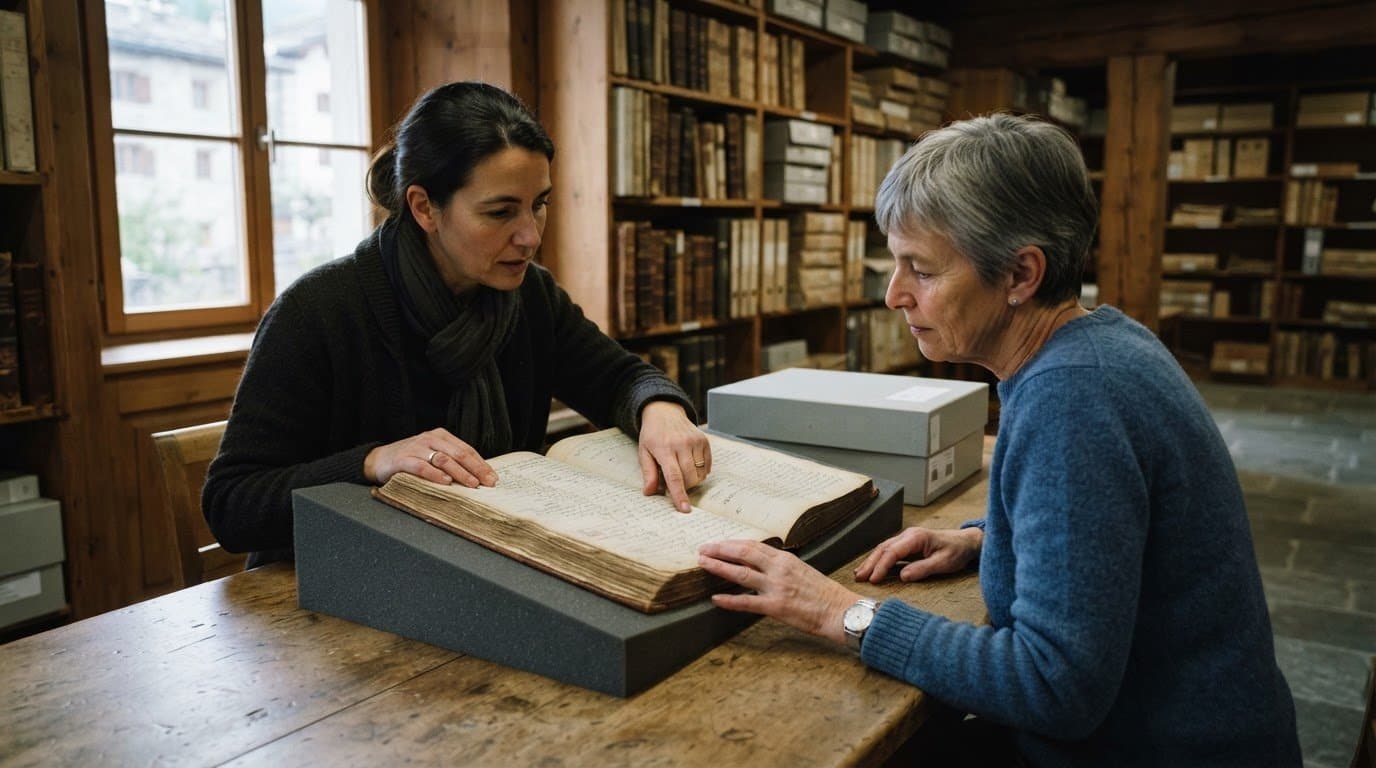
A familiar Swiss surname may appear in more than one spelling, so the name alone may not pinpoint your family’s roots. A genealogy trip to Switzerland is best focused on the ancestor’s canton and hometown: Switzerland has 26 cantons, each with its own archives and official language, and records may be written in German, French, Italian, or Romansh.
That complexity is part of the appeal, but it can make family research feel difficult to plan from a distance. A surname’s history, the places your relatives lived, and the language of local records can each offer a useful clue.
Here, you’ll learn how to use those clues to narrow your search, understand where Swiss records are held, and shape a meaningful itinerary around your family’s origins. The result is a clearer path from names on a page to the canton, town, and landscapes connected to your ancestry.
Key Takeaways
- Use changing surname spellings and family naming clues to narrow the places worth researching.
- Match the date and type of family event to the records most likely to preserve it.
- Look for an ancestor’s Heimatort, which can point to a municipality beyond their birth or residence.
- Plan archive visits around the collection you need and any advance arrangements it requires.
Identifying an ancestor’s canton and language
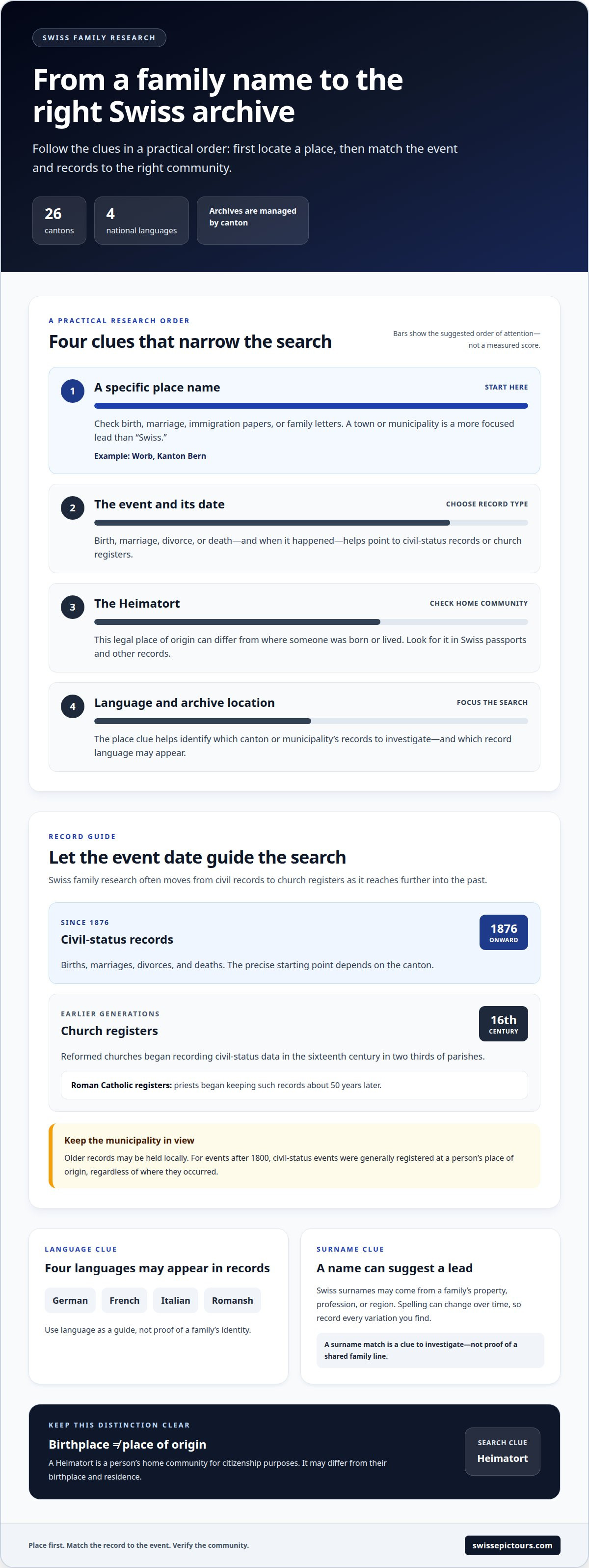
Start with the strongest place clue in a family document, not the surname alone. A birth certificate, marriage record, immigration paper, or family letter may name a municipality or canton. For example, a birth certificate identifies Myriam’s mother’s father as being from Worb in Kanton Bern. That place offers a specific regional starting point for tracing your ancestors and their stories.
Switzerland has 26 cantons, each managing its own archives and official language. It also has four national languages: German, French, Italian, and Romansh. Genealogical records may use any of them, so the ancestor’s place of origin helps narrow both the archive and the language to expect. A village name can be more useful than a broad family tradition that simply says “Swiss.”
Use this sequence to turn a name into a research lead:
- Record every spelling of the surname found in family documents, including older handwriting or translated records.
- Note each place name exactly as written, then distinguish a village or municipality from a canton or country.
- Compare the place clue with the language used in the document. Treat language as a guide, not proof of a family’s identity.
Swiss surnames may come from a family’s property, profession, or region, and spellings can change over time. A name may suggest a line of inquiry without identifying one village on its own. Search for spelling variations together: a change may reflect how a name was recorded in a different place or period.
For a genealogy trip to Switzerland, build the itinerary around the clearest place clue first. A canton and likely record language can help focus archive research and make time in the region more meaningful. If a document points to Bern, begin with its named town, then let that evidence guide the next step rather than spreading the search across all 26 cantons.
What Swiss genealogy records are available and how far back do they go
Swiss family research often moves from civil records to church books as it reaches further into the past. Swiss authorities have recorded births, marriages, divorces, and deaths since 1876. Civil records begin in the late nineteenth century, with the starting point depending on the canton. Older records may be held locally, so the ancestor’s municipality matters as much as the document date.
For earlier generations, church registers can extend the search. Reformed churches began recording civil-status data in the sixteenth century in two thirds of parishes. Roman Catholic priests began keeping such records about 50 years later. Swiss church books are considered reliable sources for family history, but surviving coverage depends on the parish and the records preserved there.
Use the event date to guide the record search:
- After 1876: Start with civil-status records for births, marriages, divorces, and deaths.
- Before civil registration: Look for Protestant or Catholic church registers tied to the family’s municipality.
- For events after 1800: Remember that civil-status events were generally registered at a person’s place of origin, regardless of where they occurred.
That distinction can explain why a record isn’t where family stories suggest. A relative might have lived or died elsewhere, while the relevant registration followed their place of origin. Swiss genealogical records are generally held by individual towns or cantons, rather than one centralized archive.
Allow for gaps, too. Swiss emigrants often didn’t report later civil-status changes back to Switzerland, leaving family registers out of date. Departure records can also be absent when emigrants left without permission and without paying the moving-away tax. For ancestry reaching back to the 1870s, relevant cantonal archives can also be consulted. Beyond documents, oral traditions, family chronicles, local museums, and historical societies may add context to names and dates. Pairing archive research with time to experience the landscape can bring a family’s regional history into sharper focus, from parish records to Switzerland’s Alpine landscapes.
How to identify an ancestor’s Swiss hometown or municipality
A Swiss ancestor’s hometown may refer to their legal place of origin, not their birthplace. Swiss citizenship is organized at three levels: national, cantonal, and Heimatort, or home community. A person’s Heimatort can differ from where they were born or lived. This distinction can redirect a family search from a remembered residence to the municipality connected with citizenship.
Look for the Heimatort in documents created outside Switzerland. Swiss passports list a person’s Heimatort rather than their birth city. Immigration, naturalization, and death records may also name it. These records can preserve a specific community name even when family stories recall only a larger region or the place where relatives settled.
The Register of Swiss Surnames can offer another lead. It lists surnames associated with citizenship in Swiss communities and gives each entry’s place of origin. Treat a surname match as a clue to investigate alongside family documents, not as proof that everyone with that name belongs to the same family line.
Build a focused search from the evidence you have:
- Collect documents naming a Swiss birthplace, place of residence, or place of origin.
- Separate the birth location from any Heimatort named in a passport or other record.
- Use immigration, naturalization, and death records to look for the home community.
- Compare the resulting place name with the Register of Swiss Surnames and your family documents.
In Myriam’s example, her mother’s birth certificate identifies Biberist, Bleichenberg, as the place where her mother was born. The suggested starting point for tracing her mother’s family was Gemeinde Biberist in Kanton Bern, with an email enquiry. The example shows why it matters to record each place exactly: a birthplace and a home community can serve different roles in your search. Once you identify a municipality, it becomes a more precise destination for exploring the landscape connected with your ancestors.
Keep the Heimatort distinct from a birthplace or residence: a Swiss person’s Heimatort is their legal place of origin and may differ from where they were born or lived. Immigration, naturalization, and death records may help identify it. A municipality named in one of these records can be a useful lead, but it does not necessarily indicate the ancestor’s birthplace or a place where they lived.
Do Swiss archives require appointments or advance research requests
There is no single appointment rule for every Swiss archive. Genealogical records are generally held by individual towns or cantons, so arrangements depend on the institution that holds the material. Before planning a visit, identify the likely archive and send a focused enquiry about the records you need, whether an appointment is required, and how to request access.
Make your enquiry specific. Include the ancestor’s full name, known name variations, municipality or canton, and the dates and events you’re researching. Say whether you’re seeking a birth, marriage, death, or family-register entry. A clear request helps the archive identify relevant holdings and explain its consultation process.
Research authorization is a separate consideration. Swiss cantonal research authorization under the Federal Civil Registry Ordinance is subject to a fee set by the canton. If your work involves civil-status research, ask about authorization in your advance enquiry. The amount is set by the canton, so don’t assume one fee applies throughout Switzerland.
Use this preparation sequence before travelling:
- Pinpoint the ancestor’s municipality or place of origin from family documents.
- Identify whether the likely source is a town or cantonal archive, or a church register.
- Send the archive a concise request with names, places, event types, and relevant dates.
- Ask about appointments, document retrieval, access conditions, and any authorization needed.
A place-of-origin search needs particular care: Swiss records held there include only documents sent to that place. A relative’s residence elsewhere may not lead to the record you expect. Advance correspondence can clarify which collection to consult and whether a visit makes sense before you build your itinerary around it.
Once the research stops are defined, leave room for the journey between them. A Swiss Alps private tour can add a scenic regional experience alongside archive visits, without crowding your research schedule.
Swiss church records, especially Protestant and Catholic registers, are commonly used to research births, marriages, and deaths. Descendants of Swiss citizens may inherit citizenship in a home community they have never visited.
Swiss Epic Tours
Swiss Epic Tours can make the journey between family-history discoveries and Switzerland’s remarkable regions part of one considered itinerary. Once you’ve identified a canton or municipality, private day tours in Switzerland and Swiss Alps private tours let you experience the landscapes and towns connected with your research. For a broader journey, the Multi-day Grand Tour of Switzerland can bring several regions together in one trip.
The right choice depends on how far your family clues reach and how much time you want to spend exploring beyond archive visits. A Zurich City Tour can suit an itinerary that begins in the city, while a private tour offers a personal way to experience the country’s distinct regions.
For a journey that pairs family discovery with Switzerland’s scenery, contact Swiss Epic Tours.
Let Your Family Story Shape the Journey
A genealogy trip to Switzerland can be more than a sequence of archive visits. Let the family clue you’ve uncovered guide the pace and character of your time in the country, with room to experience the places and landscapes that bring its history to life.
Swiss Epic Tours offers ways to see Switzerland around your research, from a Zurich City Tour to Swiss Alps private tours or the Multi-day Grand Tour of Switzerland. Choose the journey that suits your plans, whether you want to explore one region or travel more widely.
Your next step can be simple: shape an itinerary that gives your family discoveries room to breathe, alongside the pleasure of being in Switzerland. Contact Swiss Epic Tours to begin planning a journey that brings your research and the country’s remarkable landscapes together.
Frequently Asked Questions
How to plan a genealogy research trip to Switzerland?
Begin a genealogy trip to Switzerland by tracing family documents to the last known Swiss municipality, then confirm its spelling and canton before choosing an archive or parish collection. Check access rules and appointment requirements in advance, and bring names, approximate dates, religious affiliation, and variant spellings. Keep research days flexible for local opening schedules. Swiss Epic Tours can provide private, driver-guided travel between sightseeing stops, but genealogy record searches need separate planning.
What are the best Swiss genealogy libraries and research centers
Swiss genealogical records are generally held by individual town or cantonal archives, rather than one centralized archive. Church registers, local museums, and historical societies can also support family-history research.