
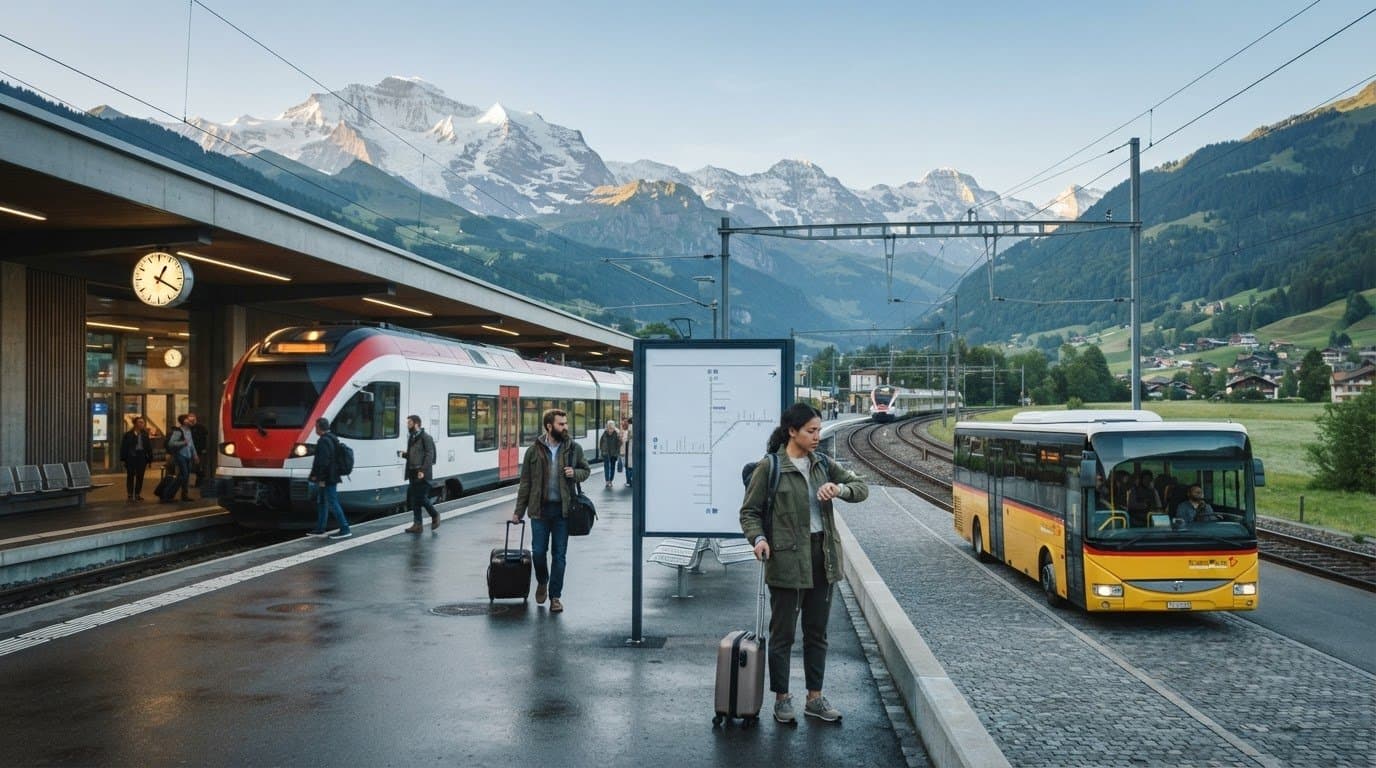
Switzerland’s public transport can be impressively well connected, yet a day built around several departures may still feel rushed. That’s often the problem with swiss public transport schedules: the timetable isn’t necessarily at fault; it’s the tight chain of transfers, activities and onward connections around it. A missed connection or a service that stops running earlier than expected can change the pace of the day.
If coordinating trains, buses and other modes feels complicated, you’re not alone. A schedule can be accurate and still leave little room for a leisurely meal, a scenic detour or an unexpected delay. The key is to distinguish a timetable issue from an itinerary that asks too much of the available time.
This article will help you build a more realistic plan, allow suitable time between connections and decide when public transport, a private journey or a combination makes sense. You’ll also learn how a tailor-made, driver-guided journey can offer more personal pacing on a schedule-heavy day, while keeping public transport part of a thoughtful Swiss travel plan.
Key Takeaways
- The problem with swiss public transport schedules often comes down to itinerary complexity, not an unreliable timetable.
- Spot fragile plans by checking how many transfers, tight connections and fixed-time activities they depend on.
- Choose transport based on your preferred pace and comfort with managing connections, rather than assuming one option suits every day.
- Build a calmer itinerary by prioritising what matters, allowing realistic time between journeys and checking schedules before departure.
- Consider a tailor-made private guided journey for days when personal pacing and coordinated travel matter most.
The problem with Swiss public transport schedules: why planning can feel harder than expected
Planning a day that combines trains, buses, boats and mountain transport can feel demanding, even when each service has a clear timetable. The challenge is coordinating the whole journey: checking departure times, allowing time to change modes and making sure each connection fits the experiences you want to enjoy. Switzerland’s dense railway network helps connect journeys, but a connected system still asks travellers to make decisions at each stage.
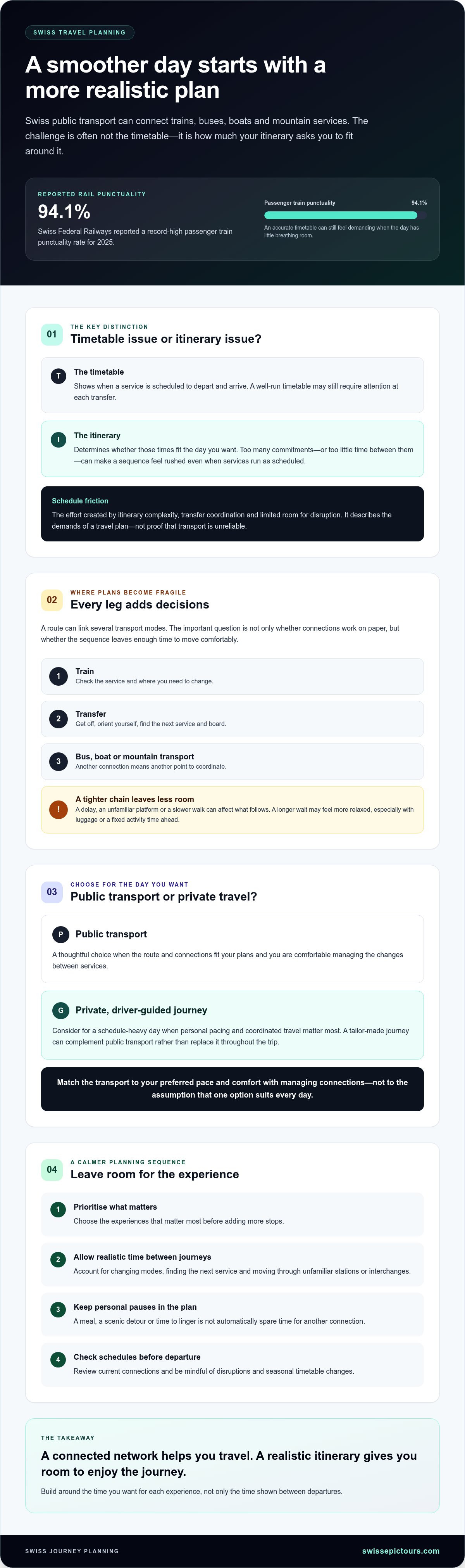
Schedule friction is the effort created by itinerary complexity, transfer coordination and limited room for disruption. It describes the demands of a travel plan, not proof that transport is unreliable. That distinction matters. Swiss Federal Railways reported a record-high passenger train punctuality rate of 94.1% for 2025. A well-run timetable can still be difficult to manage if a visitor has little time to interpret instructions, change platforms or adjust when an activity takes longer than expected. The problem with swiss public transport schedules is often the pressure created by the plan built around them.
Why an accurate timetable can still feel difficult to follow
Every additional leg adds decisions: which service to take, where to change and how to get from one mode to the next. For someone unfamiliar with local stop names, platform information or transfer instructions, those details take attention that a regular traveller may barely notice. A train connection followed by a bus, boat or mountain service can therefore feel mentally demanding, even when the published information is accurate. Complexity alone doesn’t mean the network is poorly operated; it means the traveller has more details to coordinate.
The difference between a schedule issue and an itinerary issue
A timetable tells you when a service is scheduled to depart and arrive. Your itinerary determines whether those times fit the day you want. Consider a traveller planning several activities across the country, with a different transport mode between each and a fixed arrival time for the final stop. Even if every connection runs as scheduled, a long visit, a slower transfer or a short pause can make the sequence feel rushed.
That’s an itinerary issue: too many commitments, or too little breathing room, for the available travel time. Reviewing the timetable helps you understand the journey, but it can’t make an overfilled day feel leisurely. Start by deciding which experiences matter most, then shape the connections around them rather than treating every possible stop as essential.
How Swiss public transport schedules connect services: where plans become fragile
Timetable information helps travellers piece together journeys across Switzerland’s integrated and highly developed transport network, bringing departure times and connections into one plan. A route might combine a train with a bus, a boat or mountain transport. The useful question isn’t only whether the services connect on paper, but whether the sequence leaves you enough time to move between them comfortably.
Every transfer adds a planning decision: you need to know where to go next, how much time you have and what to do if the connection changes. One change may feel straightforward. Several in a row create more points where a delay, an unfamiliar platform or a slower-than-expected walk can affect the rest of the day.
Transfers, waiting time and the shape of a travel day
A connection takes more than the time shown between arrival and departure. You need to get off, orient yourself, find the next service and board. The right connection depends on the journey and how comfortable you are navigating an unfamiliar station or interchange. Don’t choose an itinerary solely because it’s the fastest listed. A longer wait may make the day feel more relaxed, especially if you’re carrying luggage or have a fixed activity time ahead.
Separate planned journey time from the time you need for an unhurried day. The timetable measures travel and scheduled waiting; it doesn’t include how long you want to linger over a view, take a meal break or recover after a busy stretch. The problem with swiss public transport schedules can emerge when those personal pauses are treated as spare time to remove so you can squeeze in another connection.
Disruptions, seasonal changes and timetable checks
Schedules can change, and planned works or weather-related conditions may affect some services, particularly when a journey involves mountain transport. Check current information from the relevant operator close to departure, then review it again before important connections. This is especially useful when your next activity has a fixed start time or your route depends on several services in sequence.
For each connection, confirm the departure point, service time and any current notices. If a connection no longer fits, consider adjusting the day instead of preserving every stop at the expense of a comfortable pace. If the day involves particularly intricate coordination, compare public connections with a tailor-made private journey, which can be planned around your preferred pace.
Public transport or private travel in Switzerland: which suits your itinerary?
There’s no single best way to travel across Switzerland. The right choice depends on how many stops you want to make, how firmly timed your plans are and whether you enjoy managing connections independently. For a simple journey with room to adjust your day, public transport may be a natural fit. For a carefully planned series of stops, a private guided journey may make it easier to set a pace around your priorities.
Use this comparison to match your travel style to the day, rather than treating one option as universally superior.
| Consideration | Public transport | Private guided travel |
|---|---|---|
| Connections | You follow published services and manage transfers yourself. | A driver-guided itinerary can coordinate travel between planned stops. |
| Pace | Works well if you’re comfortable following set departure times. | Can suit travellers who value a more personally paced day. |
| Itinerary | A practical choice for straightforward journeys and flexible plans. | Worth considering for a day with several planned stops or more complex logistics. |
| Guided context | You explore independently and arrange any interpretation yourself. | A professional guide accompanies the journey and provides guided context. |
When public transport is a natural fit
Choose public transport if you’re comfortable checking service information, finding your connection and adapting your plans when needed. It can suit a straightforward journey between stops, especially when you have fewer fixed appointments and can let an activity run longer. You don’t need private transport for ordinary trips; the question is whether the connections and pace work for your itinerary.
When private guided transport may reduce planning friction
A private guided journey may be useful for a day that combines several planned stops, when you’d rather focus on the experience than coordinate each transition. Swiss Epic Tours offers tailor-made private, driver-guided day trips and multi-day journeys with professional multilingual guides. This is not a public transport service. It’s a separately planned journey built around the traveller’s itinerary and preferred pace. For more context on premium travel styles, explore this guide to luxury travel in Switzerland.
The problem with swiss public transport schedules isn’t that one mode always fails. It’s that your preferred pace and the demands of a particular itinerary may not align. An older discussion of challenges to Swiss punctuality also illustrates how high expectations can make even minor delays feel consequential. Consider how much coordination you want to handle, then choose the option that lets you enjoy the day without making every connection its central concern.
How to plan around Swiss public transport schedules without overloading your day
A rewarding day isn’t the one with the most stops; it’s the one that leaves room to enjoy the experiences you chose. Build the day around priorities, not the maximum number of stops. This helps turn timetable research into a manageable plan, with connections and pauses treated as part of the journey rather than obstacles to rush through.
A simple sequence for building a realistic itinerary
- Choose the essential experience. Decide what you most want from the day before adding secondary stops. If time becomes tight, you’ll know what to protect.
- Check the complete journey. Review the outbound and return routes, every transfer and the services needed to reach planned activities. Don’t assess one connection in isolation from the rest of the day.
- Allow breathing room. Leave realistic time for transfers, finding the next departure point, meals and breaks. Avoid filling every available gap with another commitment.
- Choose what can flex. Identify a secondary stop or activity you could shorten or skip if travel takes longer than planned. For an important connection, consider in advance what alternative journey or adjustment might work.
- Make a final timetable check. Shortly before travelling, review current information from the relevant operators. Check again before key connections, especially if your plans depend on a fixed activity time.
How to make a plan more resilient
Think of unallocated time as useful space, not wasted time. A pause can absorb a slower transfer or let you linger somewhere memorable without putting the rest of the itinerary under pressure. If plans change, having one adjustable activity gives you a practical way to respond instead of trying to preserve every stop.
This is especially valuable on days that combine several modes or include activities with set operating times. If a connection changes, first check current operator information, then decide which part of your plan can move. You’ll protect the day’s central experience without turning a minor change into a scramble.
For broader preparation, see this Switzerland trip-planning guide for 2026. If a complex day would be easier with a coordinated, personally paced itinerary, explore tailor-made private journeys with Swiss Epic Tours.
A private Swiss journey can complement public transport when flexibility matters
Public transport can remain a natural part of a Swiss trip, while a private guided journey may suit particular days when several planned stops, transfer coordination or a more personal pace matter more. It’s a selective choice, not a verdict against the network. The problem with swiss public transport schedules is often that a specific itinerary feels too tightly connected, not that every journey needs a different way to travel.
What a driver-guided journey changes, and what it doesn’t
With public transport, travellers check the services, follow the timetable and manage each change themselves. A private driver-guided journey offers a different arrangement: a guide and vehicle accompany the planned itinerary, reducing the need for travellers to coordinate each leg between public services. Swiss Epic Tours provides tailor-made private day trips and multi-day guided journeys, with professional multilingual guides and modern luxury vehicles.
This isn’t a public transport service, nor does it replace a published timetable. It’s another way to structure a day. The journey still needs to be planned around the traveller’s priorities, and no mode should be assumed to remove every timing consideration. A private option may be worth considering when you’d rather spend less attention managing multiple connections and more attention on the experiences themselves.
Choosing the right mix for your Swiss trip
A balanced itinerary can use public transport where its connections fit comfortably and consider private travel for days when flexibility or coordinated movement between several planned stops matters more. For example, you might prefer independent travel on a straightforward journey, then choose a driver-guided option for a schedule-heavy day when personal pacing and a guide’s context matter to you. The best mix depends on the day, not on a rule that one mode must serve the entire trip.
If you’re considering a tailored journey, think about what you most want to experience, how much structure you prefer and where you’d appreciate more flexibility. Sharing those priorities and your preferred pace helps shape a plan around what matters to you. This overview of guided day trips in Switzerland offers an example of private guided travel.
Choose the arrangement that lets you enjoy the journey, not just manage it. If a personally paced, driver-guided itinerary sounds right for one part of your trip, explore Swiss Epic Tours’ tailor-made private day trips and multi-day journeys as an option to complement public transport.
Plan a Swiss journey that leaves room to enjoy it
The problem with swiss public transport schedules is often less about the timetable itself and more about how tightly an itinerary depends on transfers, fixed activities and limited breathing room. A realistic plan starts with your priorities, checks the full journey and leaves space for breaks or adjustments. Public transport can suit straightforward days, while a private journey may be helpful when several stops or personal pacing matter more.
You don’t have to choose one approach for your entire trip. Use public transport where its connections fit comfortably, and consider a guided journey for days when coordinating each leg would distract from the experience. Swiss Epic Tours offers tailor-made private day and multi-day journeys with professional multilingual guides and modern luxury vehicles, planned around your preferences.
If you’d like a more personal way to experience Switzerland, explore a tailor-made Swiss journey with Swiss Epic Tours. With a thoughtful plan and the right travel style for each day, you can focus less on the next connection and more on the landscapes and moments that brought you here.
Frequently Asked Questions
Is Swiss public transport difficult to use for first-time visitors?
It can take some getting used to, but first-time visitors can manage it by checking their route and connection details before setting out. The main challenge is often coordinating several steps, such as finding the next departure point or allowing time to change services, rather than understanding one timetable. Start with a straightforward journey, keep the day’s plans flexible and check current operator information as you travel.
Why do Swiss train and bus connections sometimes feel complicated?
Connections can feel complicated because each leg adds details to track: departure times, stops, transfer points and instructions for the next service. The problem with swiss public transport schedules often lies in coordinating these details with activities that have fixed start times. An unfamiliar station or a short connection can add pressure, even when the published timetable is clear. Reviewing the entire route together can help reveal where the plan needs more breathing room.
Can I rely on Swiss public transport schedules when planning a full day?
Use published schedules to plan, but avoid building a full day around a chain of tight connections and fixed commitments. A timetable shows scheduled services; it can’t guarantee that every personal activity will fit comfortably between them. Check the complete outward and return journeys, leave time for breaks and review current operator information before travelling. If one activity runs long, having a lower-priority stop you can adjust makes the day less fragile.
What should I do if I miss a connection in Switzerland?
First, check current information from the relevant operator to see what services are available next, and ask staff for guidance if you’re unsure where to go. Then reassess the rest of your itinerary, especially any activity with a fixed start time. Decide whether to adjust a lower-priority stop or take a later connection. Before changing your journey, check the conditions that apply to your ticket or reservation.
How much transfer time should I allow between Swiss public transport services?
There isn’t one transfer allowance that suits every journey. The time you need depends on the interchange, how easily you can find the next departure point, whether you’re carrying luggage and how comfortable you feel navigating an unfamiliar setting. Don’t choose a connection only because it’s the fastest option shown. Review the transfer details and select an itinerary that gives you enough time to move between services without rushing.
Is a private guided tour more flexible than travelling by public transport?
A private guided tour can offer a more personally paced itinerary, particularly when you have several planned stops and would rather not coordinate each connection yourself. It’s a different travel experience, not a public transport service or a replacement timetable. Swiss Epic Tours provides tailor-made private day and multi-day journeys with professional multilingual guides and modern luxury vehicles. Consider this option when personal pacing and coordinated travel matter for a particular day.
Can I combine public transport with a private tour in Switzerland?
Yes. You can use public transport for journeys that fit comfortably with your plans and choose a private guided journey for a day when several stops or personal pacing make coordination more demanding. The two approaches don’t have to be an either-or decision for the whole trip. Think about what you want from each day, check your connections and choose the travel style that best supports that part of your itinerary.