What if the village named in your family story isn’t where your ancestor was born or lived? If you’re wondering how to “visit my ancestral village in switzerland,” that distinction matters. Swiss records may point to a family’s place of origin, while names, dates, and documents can raise questions before they identify a precise destination.
Standing among familiar landscapes can make the past feel closer, but a meaningful visit often starts with careful research and realistic expectations. This guide explains how to gather family evidence, narrow down a likely village, locate relevant historical records, and plan a thoughtful visit without expecting every mystery to be solved. You’ll also learn how to balance research with time to experience Switzerland, and how a private, driver-guided itinerary can make the travel portion comfortable and flexible. Start with the records, then let the place add context to your family’s story.
Key Takeaways
- Gather family documents, photographs, correspondence, and relatives’ memories before choosing a destination.
- Compare clues from different sources, and distinguish documented facts from possibilities.
- Choose between research-first preparation, independent travel, and a private driver-guided itinerary based on how much planning and support you want.
- Bring copies of relevant documents, prepare focused questions, and plan a pace that works for everyone traveling.
- A tailor-made private tour can shape the travel experience around your family-history interests and preferred pace.
Why visit your ancestral village in Switzerland? Set meaningful expectations
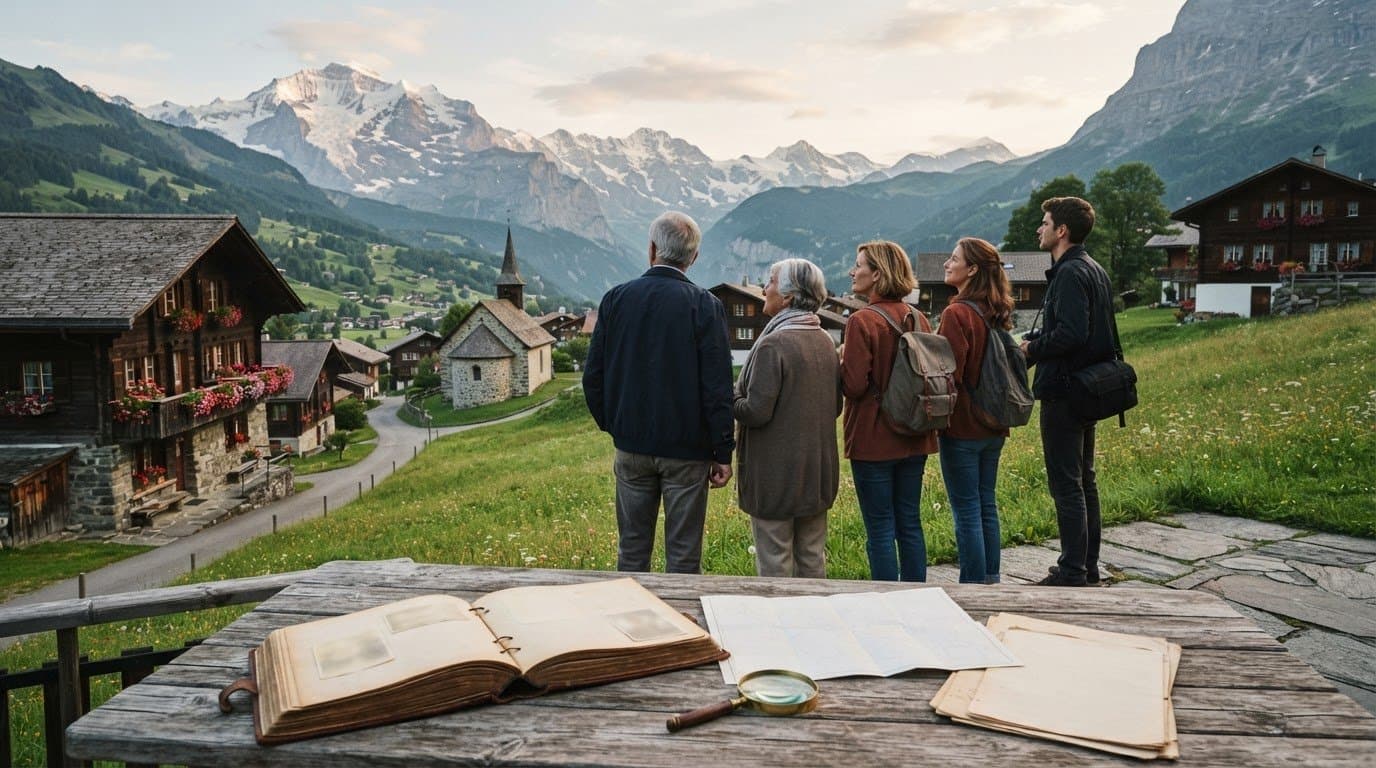
A family story can make a distant place feel familiar: perhaps a name repeated across generations, a photograph tucked into an album, or a relative’s memory of leaving a Swiss village. Visiting can bring that story into a real setting. The terrain, buildings, streets, and pace of everyday life offer context that a document alone cannot.
A visit is a personal experience, not proof that you have reconstructed a complete family tree. Research and travel answer different questions. Records may help establish where an ancestor lived or belonged; being there lets you experience the setting and reflect on what the story means to you. Keeping those goals separate helps make the trip rewarding, even when the evidence is incomplete.
What can an ancestral village visit help you discover?
Seeing a place in person can turn a name on a page into a landscape you can picture and remember. Notice how buildings sit within the terrain, how older architecture relates to newer homes, and what the surroundings suggest about daily life. For general context about a traditional Swiss village, this overview of village life may be useful, though your family’s destination may look quite different.
You don’t need to locate a particular house for the visit to matter. Buildings may have changed, be privately owned, or be difficult to identify. Focus instead on public spaces and the wider setting. If you visit a religious or community space, follow posted guidance and remember that it may be part of daily life, not simply a heritage attraction.
What should you expect if the family story is incomplete?
A surname, approximate date, or relative’s recollection can offer a starting point, but none necessarily identifies a village on its own. Spellings may vary between documents, memories can blur, and family accounts may leave out details. Treat each new name, landmark, or local account as a lead to investigate, not as proof of a family connection.
Before you arrive, decide what would make the day worthwhile. You might want to understand the landscape, share the experience with relatives, or spend time in a place associated with your family’s past. If you’re wondering how to “visit my ancestral village in switzerland,” remember that a richer sense of context can be a meaningful result, even if the visit doesn’t resolve every question.
Stay curious while keeping your conclusions grounded in evidence. Note what you observe, write down questions that come up, and distinguish family knowledge from your own impressions. A village visit can deepen your understanding without completing the story, and those notes can help guide future research.
How to trace your Swiss family roots before choosing a village
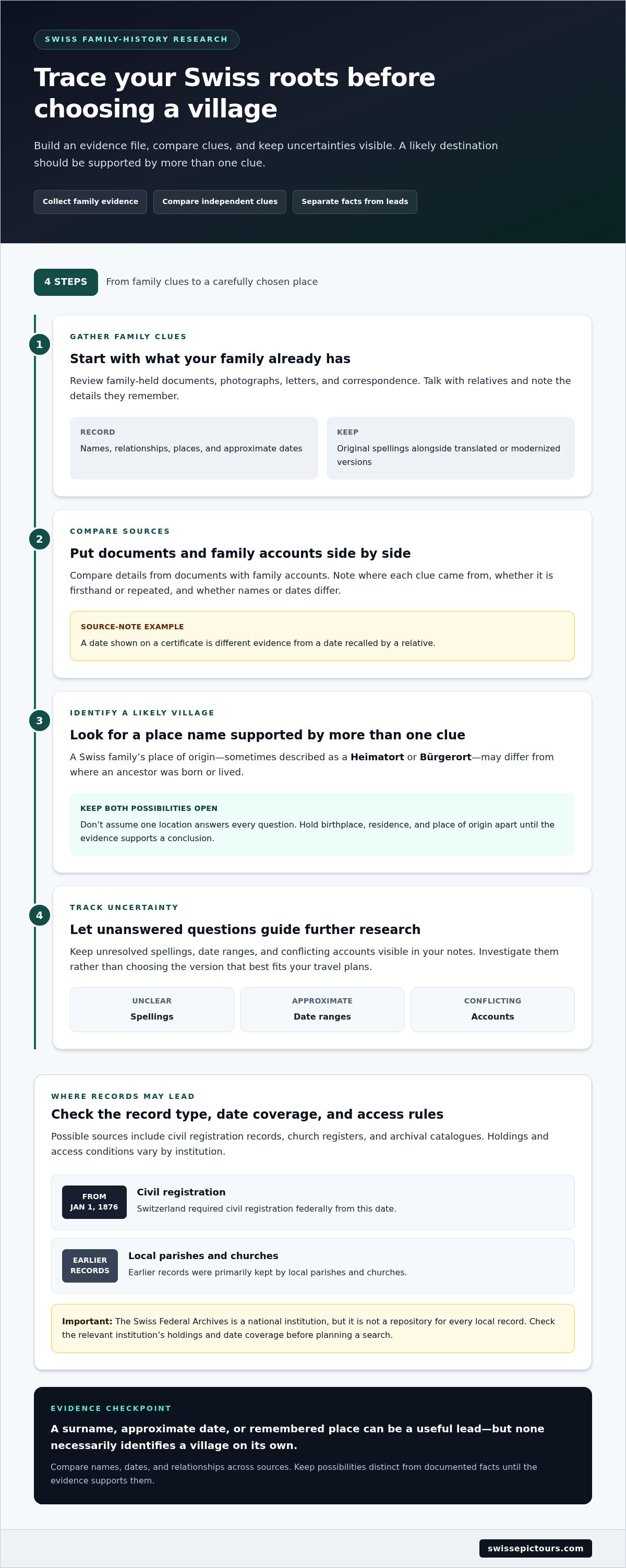
Before choosing a destination, create a simple evidence file. Start with the information your family already has, then compare clues before settling on a likely place. Swiss records are held by different institutions, and availability, date coverage, and access conditions can vary. The goal is not to find one perfect clue, but to see whether several pieces of evidence support the same conclusion.
- Gather family clues. Review family-held documents, photographs, letters, and correspondence. Talk with relatives and note names, relationships, places, and approximate dates they remember.
- Compare sources. Put details from documents beside family accounts. Record where each clue came from, whether it is firsthand or repeated, and whether spellings or dates differ.
- Identify a likely village. Look for a place name supported by more than one clue. A Swiss family’s place of origin, sometimes described as a Heimatort or Bürgerort, may differ from where an ancestor was born or lived. Don’t assume one location answers every question.
- Track what remains uncertain. Keep unresolved spellings, date ranges, and conflicting accounts visible in your notes. Use them to direct further research rather than choosing the version that best fits your travel plans.
Which family details are useful starting points?
Collect full names, possible name variants, approximate dates, and documented relationships. Keep original spellings alongside translated or modernized versions, and record the source of each detail. For example, distinguish a date on a certificate from one recalled by a relative. A source note helps you compare evidence without turning a family story into a confirmed fact.
Where might Swiss family records be found?
Possible sources include civil registration records, church registers, and archival catalogues. The Swiss Federal Archives is a national institution, but it is not a repository for every local record. Switzerland required civil registration federally from January 1, 1876; earlier records were primarily kept by local parishes and churches. Before planning a search, check the relevant institution’s holdings, date coverage, and access rules.
Compare names, dates, and relationships across sources because details may be incomplete or recorded differently. If a clue points to a place of origin rather than a birthplace, keep both possibilities in your notes until the evidence supports a conclusion. This can prevent a plausible place name from becoming a premature destination.
Once your research suggests a destination, plan the travel around what you hope to experience and how much flexibility your group needs. Swiss Epic Tours creates private, driver-guided journeys with tailor-made itineraries, offering a comfortable way to explore at a considered pace. Explore private Swiss tours as a travel option; genealogical research remains separate from the tour.
Research, self-guided travel, or a private tour: compare your options
The right approach depends on what you need from the journey. Research helps test a family story against evidence; travel gives you a personal encounter with a place. If you’re still unsure which village is connected to your family, tracing records may be the best first step. If you have a likely destination, independent exploration or a private guided itinerary can help you experience it at your own pace.
| Approach | Purpose and strengths | Trade-offs |
|---|---|---|
| Research-first preparation | Builds an organized trail of documents and clues. Helps separate what is documented from what is assumed before you plan around a place. | Records may be incomplete, difficult to access, or inconclusive. Research takes time and may not resolve every question. |
| Independent exploration | Lets you set your own pace and spend time where your interests lead. | You arrange your route, timing, and other travel details, which takes additional planning. |
| Private driver-guided itinerary | Pairs a driver-guide with a personalized itinerary, bringing comfort and flexibility to a visit shaped around family-history interests. | The itinerary supports the travel experience; it is not genealogical research and cannot guarantee answers about your family. |
When does research-first preparation make sense?
Choose this approach when the village or the connection between relatives is still uncertain. Keep a source trail so you can distinguish records from family accounts and focus follow-up research on the gaps. Research may strengthen a lead, but it cannot promise a definitive location or a complete account of your family’s past.
What can independent and private guided visits offer?
Independent travel suits people who enjoy arranging their own route and adapting plans as they go. A private driver-guided journey adds a local expert guide and a tailor-made itinerary, with room to shape the pace around your group’s preferences. Swiss Epic Tours creates private tours across Switzerland, focused on the travel experience rather than genealogy research.
Consider how much planning you want to handle, how much support would be helpful, and whether you prefer a flexible day or a more considered route. If travelers have different mobility needs, a pace that allows for breaks can make the day more comfortable. A private itinerary can be tailored to your group’s preferences, with comfort and safety in mind. Your safety, our priority.
If you’re deciding how to “visit my ancestral village in switzerland,” there is no single right format. You might research first, explore independently, or choose a private guided itinerary once you have a likely destination. Select the approach that suits your priorities, and keep evidence-gathering distinct from experiencing the place.
How to prepare for a respectful, rewarding village visit
Preparation can make the day feel less like a search for one elusive answer and more like a thoughtful encounter with family history. Bring the clues you trust, note what remains uncertain, and agree on a pace that works for everyone. Keep practical arrangements separate from family assumptions, and leave room for the place itself to shape the experience.
- Clues: Separate details supported by documents from those based on memory.
- Documents: Bring copies of relevant records, photographs, or correspondence instead of irreplaceable originals.
- Questions: Prepare a short list of names, relationships, and unanswered questions.
- Comfort: Discuss walking tolerance, rest needs, and preferred pace with everyone in your group.
- Flexibility: Leave time for reflection and unexpected discoveries rather than filling the day with planned stops.
What should you bring and organize before departure?
Prepare a concise family-history summary with a timeline of known events, full names, relationships, and alternate spellings. Note the source beside each detail, especially if it comes from a family account rather than a document. Save copies digitally and keep a travel copy accessible. Protect original records at home where possible. If you bring them, handle them carefully and avoid passing fragile or irreplaceable items around.
Before planning around an archive, religious site, or other location, check its current opening hours, access arrangements, language information, and relevant record coverage. These details can vary, so don’t assume a location will be open or that a particular record will be available to consult. Checking in advance helps you plan realistically without making the day depend on one stop.
How can you make the visit comfortable for everyone?
Talk through the day as a group before departure. Consider how much walking feels comfortable, whether anyone needs regular rests, and which moments matter most to each traveler. A considerate plan balances practical needs with time to pause, take in the surroundings, or follow a new lead. A private, driver-guided itinerary can be tailored around family-history interests and your group’s preferred pace.
Keep clear boundaries during the visit. A family connection doesn’t make a private home, active community space, cemetery, or religious site an open attraction. Follow signs and local guidance, respect privacy, and ask permission before photographing people or entering spaces that aren’t clearly public. A quiet, observant approach respects places that may still hold meaning for local residents.
If you’re planning to visit my ancestral village in switzerland, Swiss Epic Tours can shape a private, driver-guided itinerary around your family-history interests and preferred pace. Plan your private Swiss ancestral-village journey with comfort, flexibility, and care in mind. Your safety, our priority.
Plan a private Swiss ancestral-village journey with Swiss Epic Tours
A family-history trip deserves more than a route between points on a map. Swiss Epic Tours offers private, driver-guided travel across Switzerland, with local expert guides, tailor-made itineraries, and the company’s own fleet. The journey can be shaped around the places and stories that matter to your family, while leaving time to enjoy the landscape along the way.
The roles are distinct: your family-history research establishes the clues and questions; Swiss Epic Tours helps you experience Switzerland through a personalized travel itinerary. A tour is not genealogical research, a promise of access to private property or archives, or a guarantee that a family mystery will be solved. It is a considered way to bring the travel part of your story to life.
How does a tailor-made visit support a family-history trip?
Private travel can help a family balance different interests and comfort needs. One person may want time to reflect on a family connection, while another hopes to enjoy the scenery or spend a relaxed day together. A tailor-made itinerary can take those preferences into account and set a pace that suits your group. With a driver-guide and local expertise, the journey can feel more seamless, without requiring you to manage every part of the route yourself.
Share the clues that shaped your plans, such as a likely destination, a family story, or the kind of setting you hope to experience. Those details help give the itinerary a personal focus. Keep your research notes for reference, and treat record searches or access arrangements as separate planning matters. The tour centers on travel, comfort, and discovery, not on establishing family links.
For travelers searching “visit my ancestral village in switzerland,” a good plan allows for both intention and ease. A private journey can make space for a meaningful stop without making the entire experience depend on finding one particular building or answering every question. Your safety, our priority.
What is the next step for planning your journey?
Start with what you know about your family’s Swiss roots, the places you hope to include, who will be traveling, and what pace feels comfortable. You can also describe practical preferences, such as time for quiet reflection or broader sightseeing. Clear starting points help shape the journey around your interests while leaving flexibility for personal discoveries along the way.
Your holiday should begin the moment you contact us. For a private journey shaped around your family-history interests, Plan a private Swiss journey.
Let your family story lead to a meaningful journey
The most memorable part of an ancestral journey may be what you carry home: a landscape connected to a family name, a moment shared across generations, or a fresh perspective on a story you’ve heard for years. You don’t need every detail settled before you begin. A clear sense of what matters to you is a meaningful starting point.
If the thought “visit my ancestral village in switzerland” has stayed with you, give it room to become a journey shaped by your priorities. Consider how you’d like the day to feel, who you hope to share it with, and which moments deserve unhurried attention. Those choices can turn a place in your family history into a memory of your own.
When you’re ready to bring your travel plans into focus, plan your private Swiss journey with Swiss Epic Tours. Take the next step at your own pace and let curiosity open the way to a personal discovery.
Frequently Asked Questions
Can I visit my ancestral village in Switzerland without a complete family tree?
Yes. You don’t need a complete family tree for a meaningful visit. Start with a useful anchor, such as a surname, document, approximate date, or relative’s account, and be clear about what it does and doesn’t establish. Choose a personal goal that doesn’t depend on solving the entire family history, such as understanding the landscape connected to a story or sharing the experience with relatives.
How do I find the Swiss village my ancestors came from?
Begin with family records and conversations, then compare names, dates, and relationships across the clues you collect. Civil registration records, church registers, and archival catalogues may help, depending on the period and what has been preserved. Record the source of each clue and note conflicting details. Before planning travel around a possible village, review relevant record coverage and access information.
What if I cannot find the exact ancestral village?
That doesn’t have to prevent a meaningful trip. Keep a short list of candidate places and note why each seems plausible, separating documented links from possibilities. If the evidence doesn’t point clearly to one village, don’t present a guess as family fact. You could instead plan around the landscape or broader setting suggested by your family story, then continue researching later.
Do I need a genealogist to visit my ancestral village in Switzerland?
No. Whether specialist research would help depends on your goal. If establishing a precise family link is central, deeper research may help you prepare. If your priority is experiencing a place associated with family memories, you may be comfortable traveling with the clues you already have. A private guided tour is a travel experience, not genealogy research. Keeping those roles separate sets clear expectations for the journey.
Can I visit an ancestral village with older relatives or children?
Yes. A family visit can bring different generations into a shared story. Plan around the group’s comfort, interests, and energy rather than assuming everyone wants the same pace or activities. Swiss Epic Tours offers private, tailor-made, driver-guided travel, and testimonials describe attentive support for families that include children and older travelers. Share relevant comfort or mobility needs when organizing the trip, and leave breathing room in the day.
What should I bring when visiting my family’s Swiss village?
Bring accessible copies of useful records, a simple timeline, alternate name spellings, and a few focused questions. A concise summary can help relatives keep names and relationships straight as you discuss the story. Protect original documents and avoid carrying irreplaceable items unless necessary. If your plans include an archive or religious site, review its current access guidance in advance. Be considerate of privacy in homes and active community spaces.