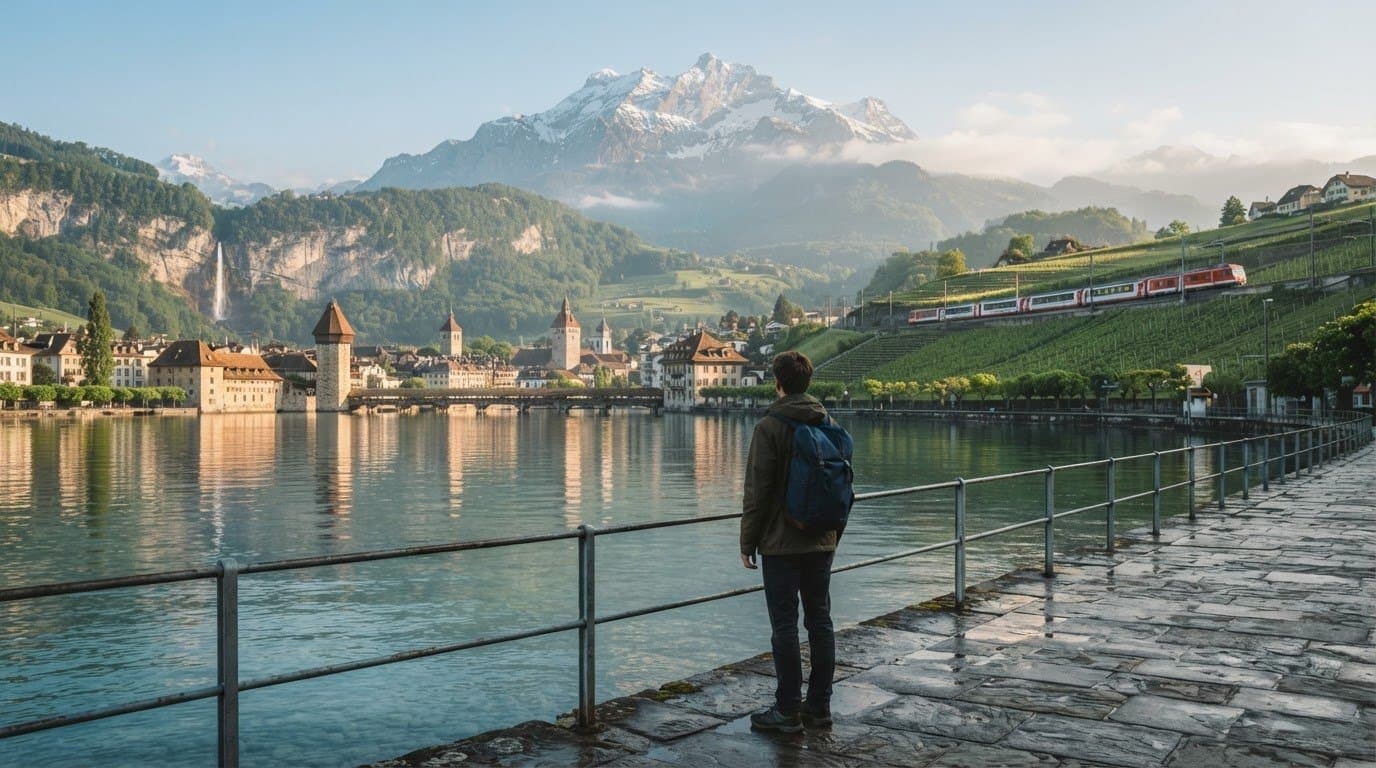
The most memorable Swiss trip isn’t a checklist of peaks; it’s a route shaped around the landscapes you want to linger in. For a week or so, focus on Lauterbrunnen Valley, Lucerne, and Bern, then choose mountain excursions and lakeside stops that suit your pace. That’s a more personal way to see Switzerland: let the Alps set the rhythm, with room for the cities and scenery that draw you in.
Switzerland’s appeal lies in its variety: a city morning can give way to a waterfall-framed valley, a still-blue lake, or a high-altitude viewpoint. It’s natural to want to see as much as possible on a first visit, but a thoughtful route can feel richer than a crowded checklist. Here, you’ll find Swiss cities, valleys, lakes, waterfalls, and mountain excursions worth considering, along with practical guidance for shaping a first-trip itinerary around the time you have. From Staubbach Falls in Lauterbrunnen to the Rhine Falls and sweeping Alpine viewpoints, discover how to bring Switzerland’s grand landscapes closer.
Key Takeaways
- For a week or so, build your route around Lauterbrunnen Valley, Luzern, and Bern rather than trying to cover every region.
- Choose mountain excursions for the experience you want, from close-up Alpine scenery to high viewpoints such as Gornergrat.
- Blend famous landscapes with a local guide’s insight to discover the stories and details that can be easy to miss on your own.
- Explore regional character through places such as Lavaux, known for its wine-growing heritage, and Appenzell, celebrated for its traditional cheese.
- Shape your first-trip plan around the time you have, balancing city visits, scenic journeys, and unhurried stops in the Alps.
1. Recommended Swiss cities, valleys, lakes, and waterfalls
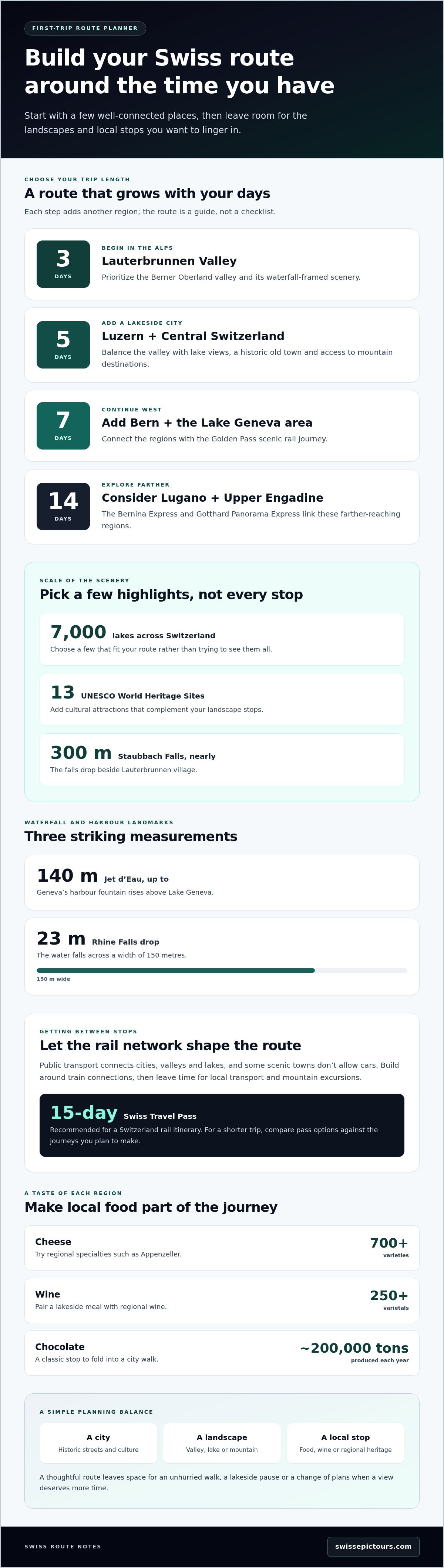
For a first travel route, choose regions by the time available rather than collecting distant stops. Switzerland has 7,000 lakes, so select a few that fit your route. With 3 days, prioritize Lauterbrunnen Valley in the Berner Oberland. Staubbach Falls drops nearly 300 meters beside the village, making the valley’s scenery immediate and unforgettable. With 5 days, add Luzern and Central Switzerland. A 7-day itinerary can include Bern and the Lake Geneva area, connected by the Golden Pass scenic rail journey. For 14 days, consider Lugano and Upper Engadine, linked by the Bernina Express and Gotthard Panorama Express.
Luzern brings lake views, a historic old town, and easy access to mountain destinations. Bern offers arcaded streets and a memorable old-town setting, while Geneva adds a distinctly French-speaking character beside Lake Geneva. Switzerland has 13 UNESCO World Heritage Sites, according to UNESCO World Heritage Centre. Choose cultural attractions that complement your landscape stops, rather than planning a full museum day in every city. In Geneva, the Jet d’Eau rises up to 140 metres above the harbour. At Rhine Falls, the water drops 23 metres across a width of 150 metres. The falls are described as Europe’s biggest by volume.
Public transport makes it practical to connect cities with valleys and lakes without driving between every stop. Switzerland’s rail network reaches just about everywhere, and some scenic towns don’t allow cars. Build the route around train connections, then leave time for local transport or mountain excursions at each base. A 15-day Swiss Travel Pass is recommended for a Switzerland rail itinerary. For a shorter trip, prioritize the stops you’ll use most and compare the pass options against your planned journeys. The route matters more than adding every scenic express to the schedule.
Food can give each region its own flavour. Switzerland produces more than 700 varieties of cheese, so try local specialties as you move between regions. Appenzeller cheese, for example, offers a taste of eastern Switzerland’s traditions. The country also produces more than 250 wine varietals. Pair a lakeside meal with regional wine, or make a market stop part of a city walk. Swiss chocolate is another classic, with about 200,000 tons produced each year. These are simple ways to bring local culture into a scenic itinerary.
Keep the schedule personal: choose a city, a landscape, and a cultural stop for each stretch of your trip. That balance leaves room for an unhurried walk, a lakeside pause, or a change of plans when a mountain view deserves more time. A thoughtful route might begin in Bern, continue to Lauterbrunnen, and finish beside Lake Geneva. For a more personal way to see Switzerland, let transport connect the highlights while your interests decide where to linger.
2. Alpine scenery and mountain excursions
Switzerland’s mountain scenery changes dramatically as the route climbs from lakeside towns into high Alpine country. The country has over 10,000 named mountain peaks, so choose excursions by the experience you want, not by trying to see them all. For iconic scenery, the Matterhorn is a striking landmark near Zermatt. Its striking profile rewards time in the valley as well as a trip to a high viewpoint. At Matterhorn Glacier Paradise, the cable car station stands at 3,883 meters. That altitude gives the excursion a distinctly high-mountain character.
For a classic central Switzerland outing, compare Mount Pilatus and Jungfrau. Mount Pilatus rises 7,000 feet above Lucerne, pairing a dramatic summit with nearby lake scenery. Jungfrau exceeds 11,000 feet, and its surrounding region offers a powerful sense of the Alps’ scale. Pick one mountain experience that complements your itinerary, then leave space for the journey itself. A lift, train, or mountain road can reveal a sequence of changing views, from forested slopes to exposed rock and snow.
Not every memorable excursion needs a famous summit. Near Lake Lugano, Monte Generoso reaches 1,701 metres and offers a southern Alpine perspective. In the Neuchâtel Jura, Creux du Van forms a vast natural basin, with vertical rock faces reaching 200 metres. The Gelmerbahn is described as one of Europe’s steepest funicular railways, making the ascent part of the experience. These contrasting landscapes show why a beautiful mountain itinerary can include more than the best-known peaks.
Let the season shape your plans. Summer excursions can combine mountain transport with hiking, while in colder conditions, accessible viewpoints and shorter walks may be more practical. Before setting out, choose a base, identify the mountain you want to visit, and plan the onward connection. Keep a flexible alternative in mind, such as a lakeside stop or a lower valley walk. This approach helps preserve the day’s rhythm if clouds or changing conditions obscure a summit.
For a high-altitude day, consider how the ascent fits your pace and interests. Matterhorn Glacier Paradise offers an elevated viewpoint; Pilatus brings a mountain outing close to Lucerne. The best choice depends on whether you value a famous peak, a scenic ride, or time outdoors. A privately guided Swiss Alps excursion can help bring a mountain route and its surrounding scenery together in one carefully planned day.
3. Alpine viewpoints and excursions
A viewpoint can make an Alpine landscape feel intimate, not distant. Gornergrat offers a memorable example above Zermatt. The train ride from Zermatt to Gornergrat takes 37 minutes, carrying you from the village toward a sweeping mountain panorama. At about 10,272 feet, Gornergrat gives the surrounding peaks and glaciers a remarkable sense of scale. The journey itself becomes part of the excursion, with changing views unfolding along the way.
Choose a viewpoint based on the kind of day you want. Gornergrat suits travelers who value a scenic train ride and dramatic views. Another excursion may appeal more if you prefer a cable car, a summit stop, or time on a walking path. Let the route guide your decision. A high viewpoint can be the day’s main event, while a lower valley walk makes a gentler companion before or afterward.
For a first Switzerland travel itinerary, plan one major viewpoint between city stays rather than squeezing it into every transfer day. Zurich or Geneva can anchor the urban part of your visit, while Zermatt offers a distinct mountain setting. Give the excursion its own pace: travel to the departure point, make the ascent, pause to appreciate the view, then descend without rushing to another distant stop. This leaves room to take in the landscape.
Conditions can change what a viewpoint reveals, so build the day around the experience rather than a single photograph. If clouds soften a summit panorama, a village walk or sheltered stop can still make the outing worthwhile. Before setting out, identify the ascent route, return route, and a nearby alternative. This simple sequence keeps the plan coherent without turning the day into a race between transport connections.
Consider how altitude, travel time, and your preferred pace fit together. A long ascent can be rewarding if you’re seeking expansive views, while a shorter excursion may leave more time for a town or lake. If you’re interested in glacier landscapes, choose a viewpoint that makes the surrounding terrain part of the experience, not just a backdrop. For a more personal itinerary, select one defining Alpine panorama, then let its train ride, valley, and mountain setting guide the day.
The Jungfrau-Aletsch Region was selected as the first Alpine UNESCO World Natural Heritage Site in 2001. Its designation offers another way to think about an Alpine outing: not only as a search for a dramatic panorama, but also as an opportunity to appreciate a landscape in a broader context.
When choosing an excursion, consider what you hope to notice along the way as well as what you want to see from the top. A measured pace leaves room to take in the terrain, pause at a viewpoint, and enjoy the return journey without making the day feel like a checklist.
4. How can travelers explore Switzerland with local guides or host families?
A local guide can add context to familiar places, from Luzern’s historic streets to the mountain villages of the Bernese Oberland. One forum contributor booked a private guide for a group of 10 travelers in Luzern. That example shows how a guide can help a group explore together while focusing on shared interests. Before choosing a guided outing, decide what you want to understand: local history, architecture, regional food, or the landscape beyond the city center.
Make the guide’s location and subject part of your itinerary. In Bern, a walking conversation can bring the old town’s arcades and landmarks into focus. Around Lake Geneva, a guide can connect lakeside scenery with the area’s French-speaking culture. In Lucerne, you might pair a town visit with an excursion into Central Switzerland. A focused outing often works better than trying to cover several distant regions in one day. Choose one place and a theme, then leave time to explore at your own pace.
A host-family stay offers a different kind of connection. Instead of moving between landmarks with a guide, you share part of daily life in a local home. Consider whether you value conversation, home-style meals, or insight into a particular region. A stay near Appenzell, for example, could complement an interest in local cheese traditions, while a base near Lake Geneva could bring French-speaking Switzerland closer. Treat a host stay as a meaningful part of the route, not just a bed between destinations.
Plan the details before you travel. First, choose a region such as Lucerne, Bern, or the Lake Geneva area. Next, decide whether a guide or a host family better suits your interests and travel style. Allow enough time for the experience, including the journey to and from the meeting point or home. A guide works well for a focused visit or a day built around specific places. A host-family stay may suit you better if you want local conversation to shape your evenings as well as your sightseeing.
Keep expectations clear and respectful. Share your interests, preferred pace, and any food preferences before a guided visit or hosted stay. In a Swiss village, a conversation about local traditions can be as memorable as a landmark; in a city such as Lucerne, a guide can connect individual sights into a coherent story. If you want personal insight without arranging every detail yourself, a guided visit offers a structured way to explore. If you’re drawn to everyday routines, a host-family stay can offer a different perspective on the journey.
5. Which Swiss regions offer the most distinctive local experiences?
Lavaux offers a first taste of Switzerland’s cultural landscape, with terraced vineyards above Lake Geneva. Wine has been produced in this region since ancient Roman times. Visit to experience the relationship between cultivated slopes, lake views, and local winemaking traditions. Rather than treating Lavaux as a passing view from the window, plan time for a village stop and a meal featuring regional wine. The landscape tells a story of work as well as beauty.
In Appenzell, regional identity is closely tied to food and tradition. Appenzeller cheese has been made by hand in the same way for more than 700 years. A visit offers a chance to connect the local landscape with a distinctive craft, then sample the region’s flavours at a relaxed pace. Choose Appenzell if food heritage matters as much as scenery. It brings a different character from the lakeside vineyards of western Switzerland.
Fribourg offers a compelling city experience for travelers drawn to medieval architecture. Its Old Town has more than 200 Gothic facades dating from the 15th century. Walk through the historic streets slowly, looking for details on the buildings rather than treating the visit as a quick photo stop. St. Nicholas Cathedral adds another landmark, with 368 steps in its tower. The climb connects the city’s architecture with an elevated view across its setting.
For a lakeside history stop, consider Chillon Castle on Lake Geneva. Built in the 12th century, it comprises 100 buildings. Its position beside the water makes the castle feel closely connected to the landscape, not simply placed beside it. Pair a visit with time along the shoreline, where the lake and surrounding scenery offer a quieter contrast to the castle’s stone rooms and courtyards.
The Bernese Oberland offers another kind of regional experience, shaped by dramatic water and mountain scenery. Near Lake Brienz, Giessbach Falls descend in 14 stages over a length of 500 metres. The changing cascades make this a rewarding stop for travelers who enjoy nature walks and close views of waterfalls. Nearby, the Sigriswil suspension bridge sits nearly 600 feet above the valley floor, adding a striking perspective across the landscape.
Choose a region for the experience you want to remember: Lavaux for vineyard heritage, Appenzell for handmade cheese, Fribourg for Gothic streets, or the Bernese Oberland for waterfalls and valley views. A thoughtfully paced route can pair a cultural stop with an outdoor highlight. For example, combine a Fribourg walk with a later stay near Lake Brienz, or give Lavaux its own unhurried afternoon. Distinctive local experiences emerge when each place has room to feel different.
Swiss Epic Tours: Multi-day Grand Tour of Switzerland
Swiss Epic Tours can turn your shortlist of Swiss cities and Alpine landscapes into a connected, tailor-made journey. Its Multi-day Grand Tour of Switzerland suits travelers who want to experience several regions without planning every transition themselves. For a focused city visit, the Zurich City Tour offers a dedicated way to explore; Swiss Alps private tours bring mountain scenery into your itinerary with professional, multilingual guides.
Choose a multi-day tour when you want a broader route, or a private day tour when one region deserves your attention. The right format depends on how much time you have and which places you most want to experience. To discuss a Swiss journey that reflects your interests, contact Swiss Epic Tours.
Let Your Swiss Journey Take Shape
The best itinerary begins with what you want to feel, not how many places you can collect. Perhaps you’re drawn to quiet mornings beside a lake, the drama of an Alpine ascent, or the pleasure of discovering regional traditions at an unhurried pace. Let that preference guide your choices, and leave room for a place to surprise you. That’s the heart of a more personal way to see Switzerland.
As you turn inspiration into a plan, consider how a thoughtfully coordinated journey can make transitions easier and each stop more meaningful. Swiss Epic Tours offers ways to explore, from multi-day journeys to focused city and Alpine experiences. Choose a trip that fits your interests, then shape the details around the places you most want to experience.
Contact Swiss Epic Tours to start imagining your Swiss itinerary. Your next unforgettable view could be the beginning of a journey that feels entirely your own.
Frequently Asked Questions
What are the best ways to experience Switzerland beyond standard group tours?
Choose a private guided trip when you want the route and pace shaped around your interests. You might focus a day on architecture, pause longer for photography, or combine a city visit with nearby scenery instead of following a fixed schedule. Swiss Epic Tours offers tailor-made private and driver-guided tours, including private day tours in Switzerland. Decide which experiences matter most, then build the day around them.
What are the best small-group or private tours in Switzerland?
The best option depends on how much flexibility and personal attention you want. Swiss Epic Tours offers small-group tours in Switzerland and private tours, including the Bern & Gruyères Private Tour and Zermatt & Matterhorn Private Tour. A private itinerary can suit travelers with specific interests or a preferred pace; a small-group experience may suit those who enjoy exploring with other guests. Choose the style of travel that feels right for you.
How can travelers find authentic food and cultural experiences in Switzerland?
Look for regional specialties and cultural stops that fit the places on your route. At a market or local restaurant, ask what the area is known for, then choose a dish or product made nearby. In French-speaking Switzerland, explore local menus around Lake Geneva; in German-speaking regions, look for traditional bakery fare. A local guide can add context to a meal or historic visit, helping you connect the experience with its region.